Thursday, December 5, 2013

Always Adidas

5 miles this morning at 7 with Baby Girl in the jogger stroller.  It was hot, but bearable.  The same guy in a minivan who gave me the encouraging fist pump last week did so again on Lakeview.  There's a fine line between nice and creepy when being cheered on by random strangers during practice runs.  I'm leaning more toward creepy.

I went to Lynbrook's Runner's Stop to finally use my 20% off coupon that was part of the Fly With the Owls goodie bag (What an awesome giveaway!).  I was hoping to try on some Brooks or Newtons, but they did not have my size (6, in case you want to send me a pair) in stock.  I went with Ol' Reliable, Adidas Adizero.  I love the color (They have a violet tint in real life) and this particular style has served me well in the previous training cycles.


They were $88.00 with the discount!  I had to buy some Power Bar raspberry gels, too, because Baby Girl opened the package at the store.

The Stick

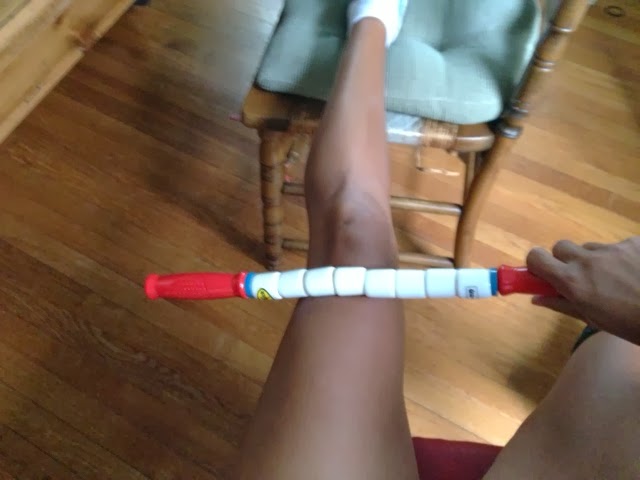
My quadriceps were still sore for yesterday's 5 miler.  Lucky for me, The Stick arrived in the mail from Amazon.  I paid $27.45 with free shipping.  Cheaper than Dick's Sporting Goods.  I couldn't wait to try it out.  How do I describe the product in one word?  How about FANfreakingTASTIC?!  Oh my God!  The relief was immediate.  The best massage of my life.  My only regret is that I didn't get this years ago.


I also purchased a pair of Reebok compression sleeves with The Stick.  They will probably arrive in the next couple of days.  I thought I might wear them in the marathon on Sunday, but trying something new on race day is a big no-no. I'll wear them during the car ride home while simultaneously rolling out the lactic acid with my Stick.  Love my gadgets and accessories!

Pumped Up Kicks and Halloween Kicks All In One

I ran 8 miles on Wednesday and 7.5 this morning.  It was a balmy 64 degrees at 7am.  I did 8 x 100m strides.  My legs felt heavy this morning.  I've been doing over 300 reps of a variety of glute exercises this past week (I also do about 400 crunches), but it feels like I'm working my quadriceps in some of the squats more than my glutes.  I'm wondering if this contributed to the "lead leg" dilemma this morning or if it was just one of those lead leg runs (which I've been known to have).  And my right knee is feeling a little "funny".  I've been wearing a brace the past couple of days.  Too much too soon?

I train with two pairs of sneakers.  I wear my older pair for my shorter runs, and then my newer pair one day a week for my long runs.  After the marathon, I decided it was time to get new sneakers.  Since I was having weird toe stiffness lately, I thought I might try a different brand of sneaker.   I actually started wearing an old pair of Nikes I discarded 5 years ago because they fit too snug.  Now they hug my toes in nicely and are practically new since I only wore them running twice when I got them.   I'm wearing them during the week and my Adidas Adizeros for my long runs.  As for my new pair, a friend recommended Asics.  He felt that nowadays most brands are pretty good, but his fast friends seem to like Asics and he thinks they feel pretty good.  I trust his opinion on all things running, so Asics it is.  I found a pair of the Gel Nimbus 15s on sale on Running Warehouse.  Normally they run between $145-$155.  I got them for $109 plus FREE SHIPPING (my two favorite online words)!  They feel nice and cushy.  I will wear them for the first time running tomorrow when I do my 12 miler.  I might wear them a couple of more times, but then I'm going to put them away until my next marathon training cycle starts again in January.  At that point, my Adidas will be my shorter run shoes and the Asics will be my long haulers.  Confused?  Yeah, me too.

Say hello to my little friend.

The three amigos.


...and I hope everyone had a fun, happy, and scary Halloween!!!

Boo!  Yes, some small children in my neighborhood cried in fear when they saw me.  
Mission accomplished.

Do you rotate sneakers too?  Did you dress up for Halloween? 

Dress For Success

Day #4 of the Runner's World Streak.  The first day of the streak, Thanksgiving, I ran the Garden City 5 Mile Turkey Trot.  The next day was tough getting out the door.  The longer I waited, the colder it got.  Temperatures were still in the 30s.  After announcing to the world that I was participating in this streak, I was very close to ending it on just the second day.  I couldn't be thatridiculous.  I finally got my arse out the door by 3:30pm for a 6+ miler.

Yesterday and today were slightly warmer than earlier in the week, low 40s.  I bought a newAvalanche running top at T.J. Maxx on Black Friday so I tested it out yesterday for an 8 miler.

Take me to your leader.
Do you love thumb holes as much as me?

The Voltiac hooded pullover was $24.99 at T.J. Maxx instead of $50.00-$75.00 online.  I wore a tank top sports bra and a Uniqlo heattech turtle neck underneath,   The Uniqlo heattech technology redistributes your body heat to keep you nice and toasty.  I love it for my cold weather runs.  However it does not wick away sweat, so when your run is over, you should immediately remove the top because it will be soaked.  The Avalanche top has a soft liner inside for warmth.  By the second mile, I realized I could have done without the turtle neck. The Avalanche inner liner also wicks away sweat.  The outer layer stretches for optimal movement.  The high scuba collar keeps your neck warm when the hood is up.  This is a perfect top for the winter, as both a base and outer layer.

Today was a balmy 43 degrees at 9am when I went out for another 8 miler.  I wore a pair of shorts, but didn't forget my hat and gloves!  I'm not crazy, you know.

Sunday, December 1, 2013

Announcing Running Gear Adviser

Runner's Tech Review is now Running Gear Adviser. All the Runner's Tech Review posts are now on this site, soon to be followed by new reviews by the Running Gear Adviser team.

Wednesday, October 26, 2011

Invisible Shoes: Almost barefoot and fancy free

Running sandals from Adventure Girl's perspective
Invisible Shoe Huaraches
MSRP $19.95 - $44.95

The Emerging Runner
Earlier this year I was contacted by Invisible Shoe to test their brand of running sandals. These shoes are designed in a similar way to the huaraches that are worn by the Tarahumara people in Mexico's Copper Canyon. Being fans of the book Born to Run by Christopher McDougall, Adventure Girl and I thought it would be interesting to try this ultra-minimal running experience.

Since I already run in Saucony Hattori's, I'd expected that I'd do well with this minimal platform. On the other hand, I thought Adventure Girl might find these thin sandals a little lacking when she negotiated the rough Montana wilds that she currently calls home.

Out of the envelope
I chose the model with a 4mm sole and the DIY (do it yourself) option. Since the Hattori's also have a 4mm outsole, I thought I could adapt to the thinner offering without much problem. The DIY process required that I measure my foot and supply that information to Invisible Shoe. In return I received a pair of black rubber forms that were textured for comfort and stability on the top, with a tire-like tread on the bottom.

I needed to locate a spot at the top of the form, where I would punch a hole and thread the lace between my toes. The form had two pre-punched holes near the ankles that were based on my measurements. I followed the instructional video on the Invisible Shoe website and laced up my sandals. The knot at the bottom, below my big toe, presented a problem with comfort but I thought I'd be okay running on grass. I wasn't.

Doing it yourself


The Experience
For the first time ever, I failed to complete a full test of a supplied product. I just couldn't do it. I'll admit that I really don't like sandals and I can't wear flip-flops, so I probably should have anticipated the problems I had. I wrapped the laces around my feet and ankles, per the website instructions, and went out in the yard to try them out.

Almost immediately I knew this wasn't for me. I got why this could be good for some people, but I found the experience painful. I tried three times to run with the sandals, but the feel of the lace between my toes and the knotted end above my forefoot were too much to bear.

Conclusion
I really like the concept and I think Invisible Shoe offers a very interesting product for people who can handle the feel of a sandal. I can't speak to the value proposition because I cannot use the shoes, but they are priced almost half of what you'd pay for a pair of Vibram Five Fingers. Read on for a real sense of the experience.

Adventure Girl
I read Born to Run a little over a year ago and I enjoyed it immensely. However, I wasn't necessarily motivated to pare down my own footwear in reaction to what I read. Several months ago Invisible Shoe approached Runner’s Tech Review about testing their huaraches designed for running. After some pondering about whether this was a good idea, given that the majority of my running occurs on rough, gravel roads, we gave our consent to Invisible Shoe.

A few days later I felt a bit silly standing barefoot on a sheet of 8 ½ by 11 white paper in the company bathroom tracing my foot with a Sharpie in order to produce a template for the Invisible Shoe folks to use in making my huaraches. There are two methods of sandal preparation offered. You can either have your huaraches custom-made and prepared for you ($39.95 - $44.95 a pair) or you can cut and prepare your own huaraches from a DIY kit ($19.95 - $29.95 a pair). The Emerging Runner opted for the latter option and I chose the former, which was why I ended up barefoot on a piece of a paper in the bathroom.

My custom-sized and prepared huaraches arrived via mail in a Tyvek envelope, not many days after we emailed my foot tracing to Invisible Shoe. I chose black laces (what I thought was a classic and discrete choice). To my surprise the sandals arrived pre-tied in the slip-on/slip-off style. True to the style’s name all I had to do was slip them on, wrap the excess lace ends around my ankles, and tie the loose lace end off. Then it was a matter of seeing how they ran!

The Verdict
My skepticism about the comfort of sandals for running was dispelled almost immediately. Running in the huaraches made me realize how much my feet sweat running in traditional socks and sneakers. Especially in the summer months! Having my feet exposed meant for a cooler, overall less sweaty run. Score one for the huaraches.

I've always been fairly weight sensitive when it comes to footwear. If I wear heavy boots on a long hike I usually end up tripping over roots and rocks towards the end of the day. The lightweight nature of the Invisible Shoe huaraches is practically unbeatable. I opted for the 6mm sole because I do a lot of running on rock surfaces. Though there is a lighter weight version (4mm sole), I still felt liberated and swift with the 6mm thickness.

I was initially concerned about the lump that the tied laces present on the underside of the sole between your first and second toes. It was clear that Invisible Shoe took efforts to flatten this knot as much as possible before sending the huaraches my way. When I walked across the linoleum kitchen floor on my way out of the house for the first test run the knot was a noticeable peculiarity. I was pleased then, to find that the knot was not apparent while running, although the Emerging Runner felt it in his pair.

I've been happy enough with the classic tying method that the sandals had in place when delivered to me, so I haven’t tried any of the other tying methods. There are a lot of options, almost all with how-to videos, available on the Invisible Shoe website.

Chafing wasn't a problem for the first half dozen runs. Shortly after that, I did have one lace that rubbed considerably on the top left of my left foot during a short run. This was because I didn't tie the lace securely before beginning my run. On the next run I adjusted the tautness of the lace and the chafing issue disappeared. That said, I wear flip flops a lot in the summer and that may have given me an advantage to adjusting to the huaraches.

Running in the huaraches made me feel light, cool, and unencumbered. I also was surprised at how nice they look. I was tempted to wear them merely walking around town.

The Concerns
As I anticipated, running on gravel in the huaraches can be problematic. The gravel roads I travel have variable size rocks and it’s not uncommon for some of the stones to be greater than an inch in diameter. Stepping on sharp rocks of this size in the huaraches hurts. Knowing this, I have to be diligent in watching my running surface to make sure to avoid the sharp, large rocks. Unfortunately, having to pay this much attention to where I place my feet means that I have less opportunity to look around and appreciate my surroundings. Since taking in the scenery is important to me, this is a drawback that gives me pause. Perhaps my feet will eventually toughen up enough to take on rocks of all sizes, but I have yet to reach that point.

What about winter? Where I live, snow comes early and leaves late. In fact, the high peaks around me were dusted with their first new snow just yesterday (September 16th). Very soon it’s going to be too cold to run barefoot. So, I anticipate that my Invisible Shoe huaraches will be retired for the cold season along with my tank tops and bathing suits, a duration that is about six months long. [Disclaimer: The flip side of this is that it hardly ever rains in the summer, which means I haven’t had the opportunity to try the sandals in wet conditions. I’m not sure that they would perform especially well.]

I try to run with my lab / chow mix as often as I can. Unfortunately, she occasionally gets distracted looking at a bird, squirrel, or neighbor’s pigs while we run and ends up stepping on my foot. This can be quite painful without the protection of a sneaker’s upper.

I’m having lots of fun with the Invisible Shoe huaraches and I've actually considered buying a pair for several running friends who I think might also enjoy the experience. If you’re a Five Fingers fan, I encourage you to take the next leap and try Invisible Shoe. I think you’ll experience yet another level of freedom and feel. I’m glad that this opportunity came my way because it revitalized my running when I was in a bit of a slump.

Running with the huaraches is fun, liberating, and occasionally, wince inducing (damn gravel!). The price tag is a bit steep if you go the custom-fit route, which I highly recommend over the DIY option, but if you can stomach it, I highly recommend giving them a try.

Here’s hoping next summer I've moved to a place with smooth dirt trails and warm, dry weather. You can guarantee I’ll be wearing the Invisible Shoe huaraches.

This review by Adventure Girl and The Emerging Runner

Sunday, June 26, 2011

Saucony Hattori Review: From the streets of NY to the mountains of Alaska

Saucony Hattori's -- Two of many colorful combinations

Saucony Hattori
MSRP $80
Saucony: http://www.saucony.com

After a year of running in lower, flatter shoes (the Saucony Kinvara and then the Mirage) I was ready to go even more minimal. The Hattori is Saucony's most stripped-down shoe, designed for runners who are looking for the least amount of material between their foot and the road (or on the trail). Saucony was good enough to supply pairs of the Hattori to me and my guest reviewer, the Harrier of the Night (HOTN), for testing.

Like most reviews we've done on Runner's Tech Review, both testers conducted independent research and supplied separate viewpoints based on our individual experiences. HOTN and I are different types of runners and our expectations for running shoes also differ.

HOTN is is a college student in Connecticut who was born and raised in Sitka, Alaska. I'm based in New York and do most of my running on the streets and trails of Long Island.  HOTN has just returned to Alaska for the summer and that's where he put his Hattori's to the test.  HOTN competes competitively in marathons, ultramarathons, and mountain running and his preference is to run in the most rustic and nocturnal settings that he can possibly find.

The Emerging Runner

FIRST IMPRESSIONS
I had some idea what to expect from this shoe based on the marketing buzz and some early reviews. When the Hattori's arrived I opened the box and observed (on the Emerging Runner) that: "The Hattori does not look like a running shoe and, if not for its sturdy mid-sole/out-sole, I would take it for a slipper with a very over-the-top design. The shoe fit me snugly and was extremely comfortable on my foot. I then tried it without a sock and it felt great."

I have gotten used to lightweight shoes having run the Kinvaras for a year, but these shoes, even at my size, still weigh in under 5 ounces.

Pool shoes (left), the original minimalist footwear
The thing that I didn't expect from the Hattori was that its simple construction would seem so similar my pool shoes. The uppers fit snugly but they stretched much like the material in a SPIbelt. If I'd had the opportunity to try on these shoes before requesting a size, I would have gone up from my usual 10.5's  to a size 11. I was concerned at first that the tight toe box would constrict my foot movement and cause my toes to blister or my toenails to blacken. Happily, this has never been the case.

To minimize the tight fit, I ended up buying a couple of pairs of Wigwam Ironman Pro socks that are thin and don't have any cushioning in the heel or toe areas. Even with more voluminous running socks, the experience has been reasonably comfortable and blister free. The fit without socks was better but I didn't like the scratchy feel of the counter along my upper Achilles tendon. Thin socks seem to be the best compromise.

FIRST RUN
The Hattori is indeed slipper-like with a narrow collar. It was a slight challenge to get them on my foot the first few times I tried. Once on, the shoes felt like a part of my foot with a zero drop and the low platform that seemed very natural. However, compared with both the Mirage and Kinvara, the Hattori lacked "spring." I think this is because the Hattori activates off the mid-foot and the spring comes from the arch and fore-foot as a kinetic response to toe-off.

Out-soles: after one use (top), after 50 miles (bottom)
The Hattori's provided plenty of proprioception, or road feel, with a thin EVA mid/out-sole that has patches of silicone-like material placed on the the heel and the (medial side) forefoot. Besides my cheapo pool shoes, I'd never run in anything that promoted a mid/front foot landing as well.

Out-sole mostly EVA with three silicone patches
It's a simple thing but my stride naturally adapted to this strike and prevented me from landing on my heel. The downside was the unexpected jolt that comes from landing on a stray piece of gravel.

Unused heel plate
No surface wear after a month's use
Running in the Hattori's felt truly natural from the start and I quickly covered five miles without any calf soreness. After 50 miles in the Hattori's the heel area remains pristine. I'm sure the time I've spent in the Kinvaras has helped strengthen my feet, ankles and lower legs. For those who are still running in higher platformed shoes, I'd recommend trying a shoe like the Kinvara, the Brooks Green Silence or the NB Minimus before moving directly to this model.

The shoes performed well during the NHP 8K
RACING
I knew I could run in the Hattori's for at least five miles without an issue so I elected to wear them during an 8K race. I scored a PR for that distance and found the shoes to be highly responsive. In fact, I ran this race at a pace almost a full minute faster than normal. I'll give the bulk of the credit for my PR to my training but the light weight of the Hattori's definitely provided an advantage in the final minutes as I battled fatigue.

OTHER  OBSERVATIONS
Style is definitely a factor in many people's purchasing decisions but for me it is the least important thing. That's a good thing because the first (of two pairs) that I received from Saucony are kind of garish, with their bright red uppers highlighted with black trim, a white mid-sole and some green elements.

Saucony supplied a second pair that are a more conservative combination of black and green.  I regret requesting the Hattori's in my normal running size because they are very snug. A half size bigger would have fit better with socks. The shoes do seem to be loosening up a little and perhaps that's intentional.

I pulled out my pool shoes to compare to the Hattori's and found many similarities. The pool shoes, with their hard rubber out-soles and waterproof insoles, weigh almost twice as much as the Hattori's. But unlike the Hattori's, the pool shoes lack any engineering to facilitate running motion. Still, with socks to protect my feet from blisters, my $15 pool shoes would be a preferable choice for me over expensive, highly constructed, running shoes with built-up heels.

BOTTOM LINE
The primary question I've asked myself for the last year is "Can I use an ultra-minimal running shoe as a daily trainer?" With the Hattori's, the answer is clearly yes. HOTN's experiences below and the light construction of the Hattori's make me a little concerned about the durability of these shoes. I'll find out over the next 12 months how they hold together and will update that experience on the Emerging Runner. In the meantime, I don't want to run in anything else.

The Harrier of the Night

I'm from Alaska, a fact of which I'm quite proud. It is a state of superlatives: the mountains are big, the trails wild, and the running is rugged. In the two weeks after I received the Saucony Hattoris, I introduced the shoes to Alaska – to the superlative – as best I could. It was a largely amicable encounter, but one from which these shoes may never recover.

FIRST IMPRESSION
When I took the Hattori's out of the box, it was further confirmation that the minimalist-running-shoe craze has metastasized to multiple shoe companies, at least for the immediate future. The Hattoris look sharp with their bright colors. Their non-traditional design seems to really strive for "innovation" – whatever that might mean in shoe world.

When I went online to check the Hattori's sticker price ($80), I was surprised because, to my mind, the material and design of these shoes did not seem to be worth $80. However, I wasn't fully surprised since the diminishing size and complexity of faddish minimalist shoes seems to produce a correspondingly large increase in price. This is akin to how the registration cost of marathons, contrary to all logic, seems to increase with the number of participants and ostensible economy of scale.

HOW THE HATTORI'S PERFORMED
While my parsimonious gripes are just that, I was pleased with how the shoes felt while running. First off, they're comfortable. Really comfortable! As I said, I introduced these shoes to Alaska the best way I could. I went running with them on road and track (of course) but also on both technical and non-technical trails and up and down mountains. I launched kayaks in them and played pick-up basketball. I wore them with socks and without. My feet were happy through it all, with few exceptions.

The Hattori's sole is thin. That's the trade-off with minimalist shoes. With thin soles, come more vulnerable feet. I thought the shoes handled flat technical trail well. If you're placing your feet intelligently, they would never suffer from contusion. When you run down a mountain, there's just too much velocity for these little shoes to handle all the impact that is transmitted to your feet. You have to slow down. But as I understand it, mountain running is a sport largely restricted to Alaska and the Intermountain West, so this is probably a non-issue for most prospective Hattori customers.

HOTN's Hattori's after use
Emerging Runner's Hattori's after the same period
HOW THEY HELD UP
The short answer is not well. After I had taken the Hattori's out five times, the webbing that constitutes the top of the shoes was giving way at the toes. The location of my big toe corresponded to the biggest hole and the holes got smaller correspondent to the size of each smaller toe.

I can't say that this is unexpected. I have a pair of mountain running race shoes (that is, shoes I only wear during races). They're 8 oz. These shoes take a beating during each race and are already falling apart after only five different races over two years. But these Hattori's (4 oz.) are not rigorous mountain or technical-trail shoes. They strike me as road running shoes and their competitor is, without a doubt, Vibram's Five Fingers. Five Fingers don't fall apart after five different outings, and that's a comparative disadvantage for the Hattoris.

Saucony seemed to anticipate the weakness of the webbing. There is a shiny stripe of lamination that strengthens the webbing along its perimeter. There are also some lateral stripes of webbing across the top of the shoe that seem to be there more for design than for function. This webbing is located precisely along the top of the shoe, a region that experiences minimal stress. Interestingly, the higher stress areas, where the toes rub up, into, and through the webbing, are free of lamination and thus, full of holes.

DESIGN
Lamination aside, the design is so-so. I'm a size 9, and shoes fit like a glove...or a good-fitting shoe. This is great for trails because a snug fit commands a podalic dexterity that allows precise foot placement as well as the ability to push off roots, boardwalk, and angled rocks.

As the Emerging Runner notes above, the Hattori's are tricky to get on your foot. You have to finaggle and wiggle them a bit. The shoes lack a tab to allow you to hold fast with your index finger while you slip your heel inside of the webbing. This is a seemingly easy-to-fix shortcoming and I'm surprised Saucony shoe engineers didn't account for it.

The color of the shoes that Saucony supplied is striking. I received a red-themed pair, and when running downhill or in a sprint, I felt like Sonic the Hedgehog with my little red shoes darting in and out of my peripheral vision beneath me.

BOTTOM LINE
I'm a pecuniary shoe cynic. Hattoris aside, most shoes probably cost just a couple dollars to make (in terms of labor and materials).  Yet, with precious few exceptions, these shoes sell at an absurd MSRP. How has this come to be? I have no idea. And so a shoe like Hattori, while great for running, is so simple you may as well just buy generic water shoes for a third of the price. You'll probably reach the same end result (just as you might as well buy wetsuit booties instead of Vibram's Five Fingers).

However, if huge profit margins and the incongruity between price and product doesn't bother you, and you don't mind buying another pair in the somewhat near future, the Hattoris are probably for you. If that were the case for me, I'd count myself as sold, so to speak, on the Hattoris. And that hypothetical aside, I know I'll be happily wearing my current pair until they fall apart entirely.

Summary

What's good:

- Ultra light weight
- Facilitates mid-foot landing
- Comfortable fit and natural feel

What could be improved:

- Durability
- More guidance on fit
- Price
- Collar design to allow easier placement on the foot

This review by the Emerging Runner and the Harrier of the Night